Can you use regular LED strips as underwater lights? The short answer is usually no. A strip designed for a kitchen, cabinet, or bedroom may resist splashes, but full immersion creates different risks. Water can reach solder joints, cut ends, connectors, and the power supply. Chlorinated pools and saltwater can accelerate corrosion. Even a bright strip may fail behind cloudy silicone.
Lighting engineer Dr. Ian Ashdown explains, “Waterproof performance depends on the complete installation, not merely the LED strip’s appearance.” That distinction matters. A reliable underwater system needs a verified IP68 rating, sealed end caps, waterproof connectors, and a suitable low-voltage driver. The strip should also be designed for continuous immersion, not occasional contact with rain. Heat still matters underwater. Water may cool the surface, but trapped heat can damage LEDs when the channel is poorly designed.
China’s top LED strip lights can offer strong options, but product claims require careful checking. Ask for test reports, operating-depth limits, chemical-resistance details, and warranty conditions. Do not assume IP68 means every connector or power adapter is safe underwater. They may have separate ratings.
The answer is not always convenient. A product can look perfectly sealed and still fail at one exposed cut point. I would test a small section before installing a long run. Also, follow local electrical-safety requirements and use professional installation near pools or fountains. The safest choice is a purpose-built underwater light, even when a regular strip appears cheaper.
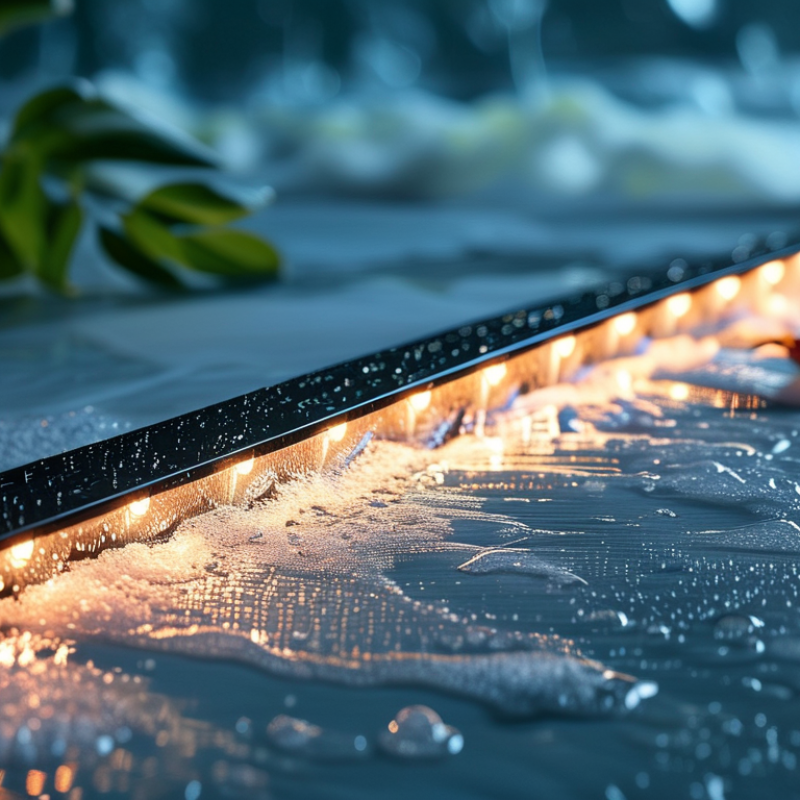
LED strip lights can work underwater, but only when their design protects every electrical path. The light itself is not enough. Look for a verified IP68 rating, which indicates protection against long-term immersion under specified conditions. However, IP ratings vary by test depth and duration. Read the technical sheet carefully.
In practical installations, low-voltage power is essential. The driver should remain outside the water and connect through suitable waterproof fittings. Fully sealed silicone jackets help prevent water from reaching the circuit board. Sealed end caps matter just as much. One small gap can allow moisture inside. It may look harmless at first.
Saltwater, chlorine, heat, and movement can weaken seals over time. Inspect the strip, connectors, and cable joints before each season. Do not cut or reconnect a wet strip. After cutting, the new end needs a correctly sealed cap. A ground-fault protection device adds another safety layer, but it does not repair poor waterproofing. Some installations fail because the strip was labeled “waterproof” without a clear immersion rating. That wording deserves caution. A qualified electrician should check the power supply, cable size, and local installation requirements, especially around pools and fountains. Depth limits are easy to overlook.
| Evaluation Dimension | Relevant Requirement or Rating | Underwater Suitability | What the Rating or Feature Means | Important Installation Considerations |
|---|---|---|---|---|
| Ingress protection of the LED strip | Limited suitability | Protection against dust and temporary immersion under test conditions defined by IEC 60529. | Suitable only for brief or occasional immersion when the product documentation confirms the intended depth and duration. It is not automatically suitable for permanent underwater operation. | |
| Ingress protection of the LED strip | Generally suitable | Protection against dust and continuous or extended immersion, with the exact test conditions specified by the manufacturer. | Check the approved immersion depth, operating time, water type, temperature range, and whether the complete assembly—not only the strip—is rated IP68. | |
| Ingress protection of the LED strip | Not suitable | Protection against water jets from limited directions, but not protection against immersion. | Appropriate for splash-prone or sheltered outdoor locations, not for pools, fountains, tanks, or other applications where the strip will be submerged. | |
| Ingress protection of the LED strip | Not suitable | Provides protection against solid objects above a specified size but has no water-ingress protection. | Use only in dry indoor areas unless the strip is installed inside a separately certified waterproof enclosure. | |
| Operating voltage | Extra-low-voltage DC, commonly 12 V or 24 V | Preferred, but not sufficient alone | Lower-voltage systems can reduce electrical risk compared with mains-voltage equipment, but they can still cause short circuits, heating, corrosion, or dangerous faults. | Use a suitable certified power supply outside the wet area. Voltage rating, current capacity, polarity, grounding, and protection devices must match the installation. |
| Power supply location | Dry, ventilated, accessible location | Required | The power supply converts mains electricity to low-voltage DC and is usually not intended to be submerged. | Keep the power supply above the waterline and protect it from splash, condensation, and flooding. Follow local electrical regulations and the power-supply instructions. |
| Connectors and cable joints | Sealed connectors or waterproof cable joints with matching protection | Required | A waterproof strip can still fail if its connectors, solder joints, end caps, or cable entries allow water to reach the conductors. | Use compatible seals, heat-shrink tubing, resin-filled joints, or manufacturer-approved waterproof connectors. Do not rely on ordinary clip-on connectors underwater. |
| End caps and cut points | Factory-sealed or properly resealed ends | Required | Cutting an LED strip can create an opening in the waterproof coating or silicone sleeve. | Cut only at marked cut points and reseal every exposed end with a compatible waterproof sealant or end cap before immersion. |
| Water environment | Fresh water, chlorinated water, salt water, or chemically treated water | Application-dependent | IP testing does not automatically prove resistance to chlorine, salt, cleaning chemicals, algae treatments, or long-term corrosion. | Confirm chemical compatibility and material suitability. Salt water and aggressive chemicals generally require additional corrosion protection and more frequent inspection. |
| Heat dissipation | Installation surface and thermal design | Must be verified | LED strips generate heat even underwater. Waterproof coatings can reduce heat transfer, while water temperature and installation surfaces affect service life. | Mount the strip on a suitable heat-conductive surface where specified. Do not tightly coil an energized strip or exceed the recommended continuous run length. |
| Electrical protection | Overcurrent protection and residual-current protection where required | Required | Protection devices help reduce the consequences of short circuits, insulation faults, and wiring problems. | Use correctly sized fuses or circuit protection. A qualified electrician should determine whether a residual-current device or ground-fault protection is required by local code. |
| Inspection and maintenance | Regular checks for cracks, discoloration, corrosion, loose seals, and water ingress | Required | Waterproof performance can decline because of aging, ultraviolet exposure, mechanical damage, thermal cycling, or degraded sealants. | Disconnect power before inspection. Replace damaged strips, cables, connectors, or seals rather than operating components that show signs of water penetration. |
Yes, but only with a verified immersion rating and fully sealed electrical connections. The light alone is not enough. Check the technical sheet carefully.
IP68 indicates protection against immersion under stated test conditions. Those conditions may include a specific depth, duration, and water temperature. It does not mean unlimited underwater use.
No. IP65 protects against water jets, not immersion. It may survive splashes. It should not remain underwater.
Keep the driver outside the water in a dry, suitable location. Use low-voltage equipment and waterproof cable fittings. A qualified electrician should check the installation.
Yes. End caps protect the cut ends and circuit board. One small gap can admit moisture. Small gaps matter.
They may, but salt, chlorine, heat, and movement can weaken seals. Inspect the jacket, connectors, and cable joints before each season. Real conditions are harsher than laboratory tests.
No. The strip may have a stronger rating than its connector. Check every connector, solder joint, and end cap separately. That mismatch is easy to miss.
Turn off power and ensure the strip is completely dry. Never cut or reconnect a wet strip. Seal the new end with a suitable cap.
No. It adds another safety layer but cannot repair damaged seals. Inspect the complete system before use. Protection is not perfection.
No. Life testing measures light performance, not waterproofing. For example, lumen-maintenance testing does not confirm immersion protection. I would recheck that assumption.
Underwater LED strip lights can be safe and effective when they are specifically designed for submerged environments. The key factors include a suitable waterproof rating, such as IP67 or IP68, fully sealed housings, corrosion-resistant materials, and reliable silicone or resin protection around the LEDs and connections. This is why the question “can you use regular led strips as underwater lights” should generally be answered with caution: ordinary strips are not designed to withstand continuous immersion, even if they appear splash-resistant.
Correct installation is equally important. Use a compatible low-voltage power supply, waterproof connectors, sealed end caps, and properly insulated cables. Before use, inspect the coating, seals, wires, and power connections for cracks, gaps, or damage. During operation, watch for water entry, flickering, overheating, or unusual odors, and disconnect the system immediately if any problem appears. Following the manufacturer’s depth and installation instructions helps maintain safe, dependable performance.

