A pool light cycling through red, blue, and green can look attractive, but unexpected flashing usually deserves attention. Homeowners often ask, “why are my pool lights flashing different colors?” The answer may involve normal programming, a failing controller, unstable power, or moisture inside the fixture.
LED pool lights commonly use RGB circuits and programmed color sequences. The U.S. Department of Energy reports that residential LEDs use at least 75% less energy than incandescent lighting and can last up to 25 times longer. However, efficiency does not prevent electrical faults. A loose connection, incompatible transformer, damaged cable, or weak remote signal can still create erratic color changes. It is easy to blame the bulb. That diagnosis is often incomplete.
Safety must guide the inspection. The National Electrical Code and UL 676 provide important requirements for underwater lighting systems, bonding, grounding, and installation. The U.S. Consumer Product Safety Commission also continues reporting serious swimming-pool electrical and drowning hazards, especially when equipment is poorly maintained. Never remove an underwater fixture while power remains connected. Do not guess with pool electricity.
A careful troubleshooting process should separate normal behavior from warning signs. Check the manufacturer’s color mode, reset the controller, and observe whether the light flickers during pump startup. Look for cloudy lenses, tripped protection, or repeated color resets. If the light remains unstable, a licensed pool electrician should test the transformer, connections, and insulation. Sometimes the controller is the real problem. Sometimes the fixture has already suffered water intrusion. Knowing the difference saves time, money, and risk.
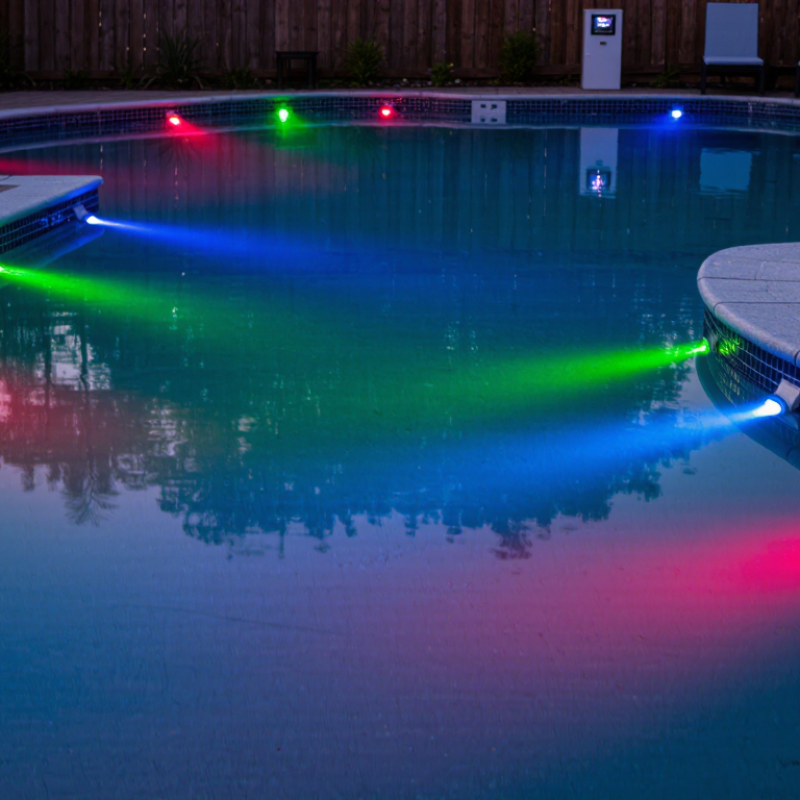
Pool lights often flash different colors because they are running a programmed sequence, not failing. Blue commonly suggests a normal swimming or relaxation setting. Green may indicate a nature-themed cycle, while purple or pink can appear during decorative transitions. White usually means the lamp is in its brightest illumination mode.
These meanings are not universal. Each lighting controller may assign colors differently. A rapidly changing sequence can indicate a color-show setting, a wireless command, or a power interruption. I have seen lights return to blue after a brief outage, even when the owner thought the bulbs were damaged. The controller had simply restarted its saved program.
Red, orange, or repeated flashing deserves closer attention. Some systems use these colors for overheating, communication errors, low voltage, or a failed control signal. However, color alone cannot confirm the problem. Water chemistry can affect visibility, but it rarely causes an electronic light to change colors by itself. Check whether all lights flash together or only one fixture does. That detail matters.
Turn the system off if the light flickers violently, becomes unusually hot, or shows moisture inside its housing. Do not open underwater equipment while energized. A qualified pool technician can test voltage, connections, seals, and the controller safely. I would not replace a lamp based only on a red flash. The interpretation may be wrong. Record the exact color pattern, timing, and recent power changes before requesting service.
Why Are My Pool Lights Flashing Different Colors?
Common Causes of Pool Lights Flashing Between Colors
Pool lights may flash between colors because their programmed cycle has been activated. Some lighting systems change colors after repeated switch toggles. A brief power interruption can also restart the sequence. Watch the light for several minutes. If the pattern repeats evenly, programming may be the cause.
Loose wiring is another common issue. During pool-light inspections, technicians often find moisture around connectors or corrosion near the junction box. These problems can interrupt power and create random color changes. Voltage fluctuations may produce similar symptoms. The light might brighten, dim, or flash unexpectedly. It may not fail completely.
Check the control switch, timer, and transformer. A worn switch can send inconsistent signals. An incompatible controller may also confuse the light’s color settings. Turn off the circuit breaker before inspecting anything. Never open an underwater fixture while energized. Pool water and electricity create a serious hazard. A qualified electrician should test voltage, grounding, and insulation resistance.
Heat can damage internal components, especially after long operating periods. A failing circuit board may cause colors to appear weak or incomplete. I have seen owners replace the entire fixture too quickly. Sometimes, a reset or loose connection explains everything. Still, guessing can waste money. Record when the flashing begins, which colors appear, and whether other lights change simultaneously. That small detail can help identify the fault.
Why Are My Pool Lights Flashing Different Colors?
Flashing colors may indicate a programmed light sequence, but irregular changes can signal a fault. I once found that a loose connection caused random color shifts after heavy rain. Start by switching off the circuit breaker before touching any equipment. Check the light lens for cracks, cloudy water, or moisture inside the housing. Never remove an underwater light while power remains connected. A damaged seal needs professional attention.
Inspect the transformer next. Look for heat marks, buzzing, loose terminals, or corrosion around the cable entries. Its output should match the light system’s required voltage. A qualified technician can test this safely with a suitable meter. Do not guess from appearance alone. A transformer may look normal while producing unstable power. I have also seen a failing timer create symptoms that seemed like a light problem.
Tips: Check whether every light flashes together or only one fixture changes color. Test the lights with the control system’s manual setting. Review schedules, scenes, and zone assignments. Replace batteries in wireless controls if needed. Resetting the controller may help, but record its settings first. Otherwise, troubleshooting can become harder. If the lights still behave unpredictably, stop repeated resets and arrange an inspection. Low-voltage pool wiring can still be dangerous near water.
Reference voltage checks for a typical 12-volt AC pool-light circuit
Start by checking the circuit with a suitable AC voltmeter. A typical low-voltage pool-light system has approximately 120 V AC at the transformer input and about 12 V AC at the transformer output and light terminals. A correct transformer reading with unstable voltage at the light may indicate a loose connection, damaged cable, or control-system issue. Always compare readings with the light and transformer nameplates, and follow local electrical-safety requirements.
Why Are My Pool Lights Flashing Different Colors?
Step-by-Step Troubleshooting for Unstable Pool Light Colors
A pool light that shifts between red, blue, and green usually has an unstable power supply, loose connection, or failing control signal. Turn the light off at the breaker before touching anything. Do not remove a wet fixture or open an underwater junction box. The U.S. Consumer Product Safety Commission reports more than 4,000 unintentional drowning deaths annually, so electrical checks should never happen while swimmers are nearby.
Check the pattern carefully. If every light changes together, inspect the controller, remote signal, or transformer. Replace the batteries in the remote, then reset the controller according to its instructions. If only one light flashes, switch off the circuit and examine visible cable damage, moisture near the junction area, or corrosion around the niche. Never pull an underwater fixture without professional training. The National Electrical Code requires pool lighting systems to use grounding and ground-fault protection, but compliance does not guarantee that an aging connection is healthy.
Next, test the light after the pump has run for several minutes. Voltage drops can appear when pumps or heaters start. A qualified electrician can measure voltage under load and test the ground-fault device. In my experience, resetting the controller often seems to solve the issue, but that fix can be temporary. A loose connection may return after rain, vibration, or heat. Document the flashing sequence and timing; those small details can prevent unnecessary part replacement.
Why Are My Pool Lights Flashing Different Colors?
A flashing pool light may have a failing LED driver, loose connection, water intrusion, or an unstable control signal. Color changes often point to communication problems between the light and its controller. They do not always mean the bulb is finished.
The U.S. Department of Energy’s Solid-State Lighting research explains that LED systems can reach roughly 25,000 to 50,000 operating hours. However, heat, moisture, voltage variation, and poor installation can shorten that life. If the light housing shows condensation, dark spots, corrosion, or repeated trips at the GFCI, stop using it. NFPA 70, Article 680, requires GFCI protection for many underwater luminaires. A licensed pool electrician should test the circuit before opening anything underwater.
Repair may make sense when the wiring, transformer, or controller is faulty and the lamp remains dry. Replacement is usually wiser when water has entered the sealed housing, the light flickers after a voltage test, or repairs approach the cost of a new unit. This judgment is not always obvious.
Tips: Turn the light off at the breaker, not only the wall switch. Record the flashing pattern and check whether other lights behave normally. Do not repeatedly reset a tripped GFCI. That small detail can reveal a larger electrical fault.
| Flashing Pattern or Symptom | Common Cause | What It May Indicate | Recommended First Check | Repair or Replacement Guidance | Priority |
|---|---|---|---|---|---|
| Colors change normally but the light occasionally pauses | Normal programmed color sequence or a temporary control signal interruption | The light may be operating as designed, especially if the pattern resumes without flickering | Confirm whether the light has a selectable color-cycle mode and check the switch or controller operation | Monitor the light. Repair is usually unnecessary unless the pauses become frequent or the light stops responding | Monitor |
| Rapid flashing between colors | Unstable power, a loose connection, failing driver electronics, or a control-system communication issue | The light is not receiving consistent power or control signals | Turn the light off and check whether other pool equipment shows power interruptions. Do not open underwater electrical components | Have a qualified pool electrician test voltage, connections, the transformer, and the light driver. Replace the light if the internal electronics have failed | Repair Soon |
| Light flashes white, then shuts off | Overheating, an internal thermal protection function, water intrusion, or a failing LED assembly | The fixture may be protecting itself from excessive heat or an electrical fault | Note how long the light operates before shutting off and inspect the pool area for visible damage or moisture around the fixture | Professional inspection is recommended. A sealed fixture with water intrusion or a failed LED assembly is commonly replaced rather than repaired | Repair Soon |
| Only one color flashes or appears dim | Failure of one LED color channel, a damaged driver, or deteriorated internal wiring | The light may have a partial electronic failure rather than a problem with the whole pool circuit | Compare the brightness and behavior of each color using the normal control settings | If the fixture is sealed, replacing the complete light is often more reliable than attempting an internal repair | Consider Replacement |
| Several pool lights flash or change colors together | Controller malfunction, incorrect synchronization, transformer instability, or a shared power problem | The issue may be upstream of the individual fixtures | Check whether all affected lights are connected to the same switch, transformer, or controller | Test the shared control and power components before replacing any individual light. Repair the common fault when identified | Repair Soon |
| Light flickers when the pump or another load starts | Voltage drop, overloaded circuit, poor connection, or an improperly sized transformer | A change in electrical load is affecting the lighting circuit | Observe whether the flashing coincides with the pump, heater, or other equipment switching on | Stop using the light if flickering is severe and arrange for a qualified electrician to inspect the circuit, connections, and transformer capacity | Prompt Inspection |
| Light remains on but ignores color commands | Faulty switch, controller, remote signal, synchronization setting, or incompatible control component | The fixture may still be functional while the control path is not working correctly | Reset the control according to the fixture instructions and verify that the switch operates consistently | Repair or replace the controller, switch, or synchronization component if the light works correctly on a basic power test | Repair Soon |
| Condensation, water inside the lens, cracked lens, or corrosion | Failed gasket, damaged lens, deteriorated seal, or fixture damage | Water may be reaching electrical components and creating a safety risk | Switch off the circuit at the appropriate disconnect and avoid handling the fixture or wiring while energized | Arrange for immediate professional assessment. A water-damaged sealed fixture is generally replaced, and the cause of the failed seal should also be corrected | Immediate Attention |
| Light is more than approximately 8–12 years old and repeatedly fails | End-of-life LED components, aging seals, degraded wiring, or obsolete control electronics | Repeated repairs may cost more than installing a modern compatible fixture | Review the light’s age, repair history, compatibility, and availability of replacement parts | Replacement is usually the practical option when failures recur or compatible parts are difficult to obtain | Consider Replacement |
| Breaker or ground-fault protection trips when the light is switched on | Ground fault, damaged cable, moisture intrusion, failed transformer, or defective fixture | A potentially dangerous electrical fault may be present | Do not repeatedly reset the breaker or ground-fault device. Leave the circuit off until it is professionally tested | Professional electrical testing is required. Replace damaged components and correct the underlying fault before using the light again | Immediate Attention |
A programmed color cycle may have started. Repeated switch toggles can activate it. A brief power interruption may also restart the sequence. Watch the light for several minutes. An even pattern suggests programming, not random failure.
Observe the colors and timing. Red, blue, and green may repeat in the same order. If the rhythm stays even, check the switch and controller settings. It may still be a faulty signal. Do not assume too quickly.
One unstable light often has a loose connection or damaged cable. Moisture near the junction area can interrupt power. Corrosion may appear as green or white buildup. Turn off the breaker before any inspection. Never open an underwater fixture while energized.
Inspect the controller, remote signal, and transformer. Replace remote batteries if appropriate. Reset the controller according to its instructions. A shared power problem may affect every light. The reset can help, but it may not last.
Yes. Pumps or heaters can create voltage drops when starting. The light may brighten, dim, or flash during that moment. Test the light after the pump runs for several minutes. A qualified electrician should measure voltage under load.
Heat can damage internal components after long operating periods. A failing circuit board may produce weak or incomplete colors. Letting the light cool may change the symptoms. That does not prove the fixture is healthy.
Note when the flashing begins and which colors appear. Record whether other lights change simultaneously. Mention recent rain, vibration, or pump activity. A short video can show the timing clearly. Small details matter.
Electrical checks near pool water are hazardous. Turn off the circuit breaker before touching anything. Keep swimmers away from the area. Do not pull a wet fixture or open an underwater junction box. A qualified electrician should test grounding, insulation, and protective devices. Safety first.
If you are wondering, “why are my pool lights flashing different colors,” the pattern may provide useful clues. Different colors can indicate a normal programmed light sequence, an active mode change, or a communication issue between the light and its controls. Unstable flashing may also result from a loose connection, moisture inside the fixture, an aging bulb or LED module, an overloaded transformer, incorrect voltage, or a malfunctioning timer, switch, or control system.
Begin by observing whether every light behaves the same way and whether the problem occurs only when changing settings. Turn off power before inspecting accessible connections, checking the transformer for unusual sounds or heat, and confirming that the control system responds consistently. Resetting the lighting cycle may solve a temporary fault, but repeated color changes, dimming, flickering, water intrusion, or tripped protection devices should not be ignored. A qualified pool electrical professional can safely test the circuit and determine whether repairing the wiring, transformer, or control equipment is appropriate, or whether replacing the light is the more reliable solution.
